ALMA ON TOUR   HISTORY   PLAY   PRESS   PHOTOS   VIDEO   INFORMATION   TICKETS Alma
  Abstandhalter  
 
 
Scenes
   Alma in Prague (2011)
   Alma in Vienna (2010)
   Alma in Jerusalem (2009)
   Alma in Vienna (2009)
   Alma in Vienna (2008)
   Alma on Semmering (2007)
   Alma in Berlin (2006)
   Alma in Petronell (2005)
   Alma in Los Angeles (2004)
   Alma in Lisbon (2003)
   Alma in Venice (2002)
   Alma in Vienna (1996-2001)
 

Location - Panorama
   Locations 1996-2011
   k.k. Post und Telegrafenamt 2012
   Prague 2011
   Jerusalem 2009
   k.k. Post und Telegrafenamt 2009
   k.k. Post und Telegrafenamt 2008
   Semmering 2007
   Berlin 2006
   Petronell 2005
   Los Angeles 2004
   Lisbon 2003
   Venice 2002
   Vienna 1996-2001

 
Venues
   Martinický Palác (Prague)
   The Russian Compound (Jerusalem)
   k.k. Post- und Telegrafenamt (Vienna)
   Kurhaus Semmering (Semmering)
   Crown Prince's Palace (Berlin)
   Castle Petronell (Petronell)
   Los Angeles Theatre (Los Angeles)
   Convento dos Inglesinhos (Lisbon)
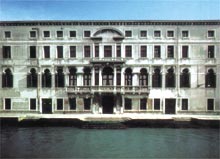
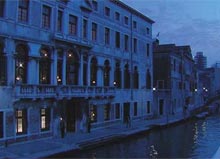
   Palazzo Zenobio (Venice)
   Sanatorium Purkersdorf (Vienna)


Palazzo Zenobio
Fondamenta del Soccorso (Carmini Church)
Dorsoduro 2596, 30123 Venezia

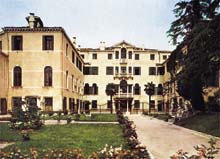
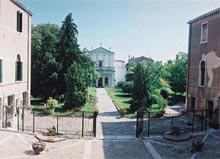
The Ca'Zenobio is a monumental building, built in late 17th and beginning of 18th century, for the Venetian noble family of Zenobio by Antonio Gaspari. Since 1850, the Palace belongs to the Armenian Mekhitarist Fathers of Venice. In the facade's rather monotonous development, it actually conceals a complex plan, in the shape of an large "C" which opens in the rear toward a handsome Italian garden.

 
Palazzo Zenobio Palazzo Zenobio
 

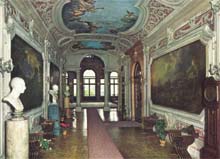
Before the entrance to the Hall of Mirrors you find the Hall of the «Stucco». On the walls, there are three precious paintings of Luca Carlevarijs, a predecessor of the Venetian 17’s view painters. The ceiling's frescos are some representation of Lazzarini’s allegories. All these frescos are framed by 17’s fine «stucco», along with the marble made door arches.

 
Palazzo Zenobio Palazzo Zenobio
 

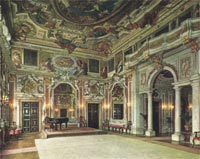
The main hall of the Zenobio Palace, is named Tiepolian after the frescos and the complex decoration, to which collaborated the young G. B. Tiepolo. A hall full of light, a subtle example of Venetian art and life in the 17 century: «Every element contributes to create this sumptuous style of the, ambience, the stuccos and the frescos, along with the bronze decoration and the mirrors».

 
Palazzo Zenobio Palazzo Zenobio